
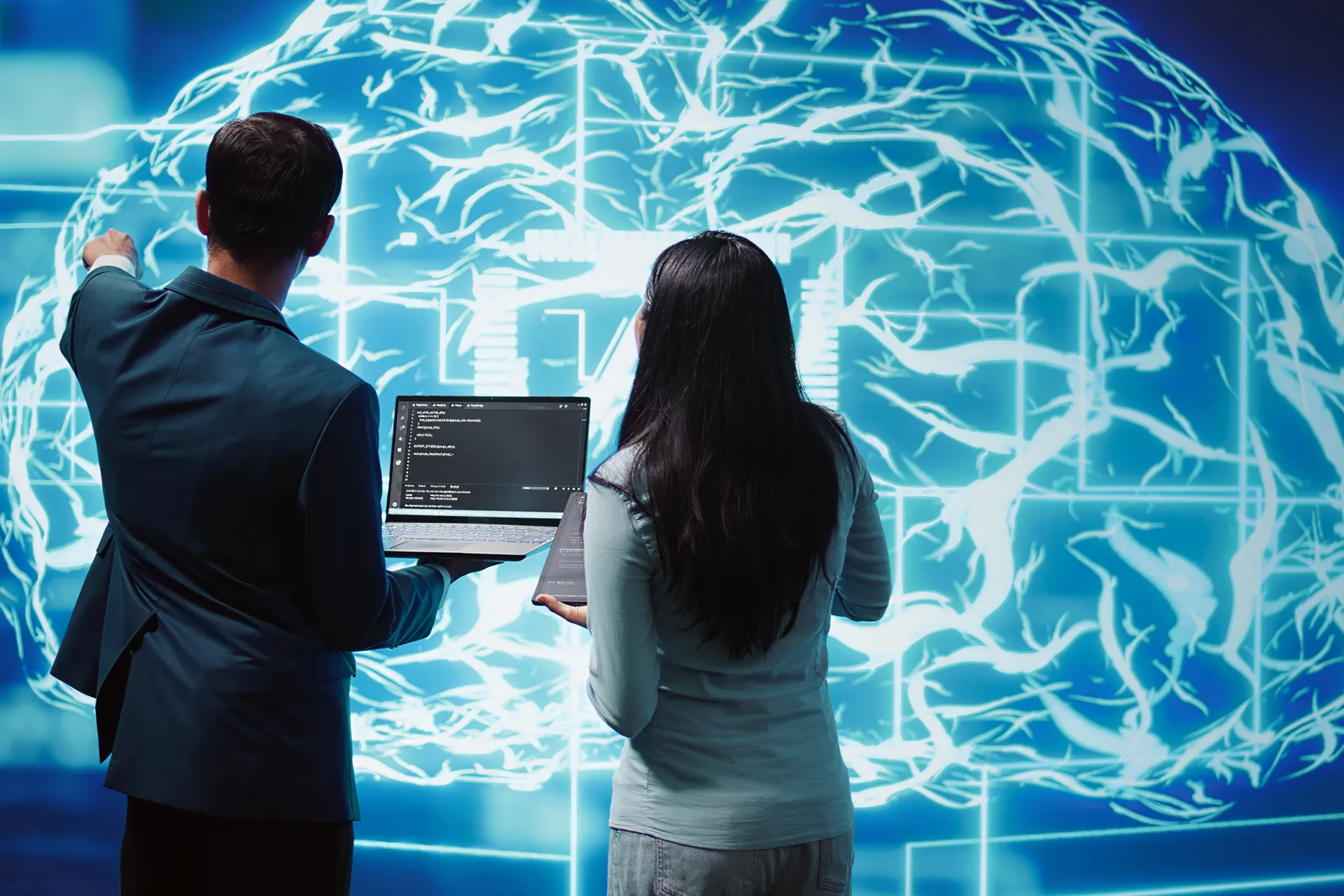
They are one of the most powerful tools in modern artificial intelligence (AI). Inspired by the functioning of the human brain, these networks use interconnected nodes, called neurons, to process and analyze complex data. Since their conceptualization in the 1940s, neural networks have evolved significantly, playing a key role in technological advances in areas such as image recognition, natural language processing, and medical diagnosis.
What Are Neural Networks?
Neural networks are computational models that mimic the behavior of the human brain. They are made up of interconnected nodes, or neurons, organized in layers to learn patterns from data. Warren McCulloch and Walter Pitts proposed the first mathematical model of artificial neurons in the 1940s, laying the foundations for the development of this technology.
How Neural Networks Work
- Structure: A typical neural network is composed of three layers: the input layer, which receives the initial data; the hidden layers, which process the information; and the output layer, which generates the final result. The hidden layers can be multiple, depending on the complexity of the task.
- Data processing: Each neuron receives multiple inputs, performs a weighted sum of these, and then applies an activation function that introduces non-linearity, allowing the network to learn complex patterns. The output of each neuron is transmitted to the neurons of the next layer, continuing the process until it reaches the output layer.
- Training: Training a neural network consists of adjusting the weights of the connections to minimize prediction error. This adjustment is carried out through optimization algorithms, such as gradient descent, which adjusts the weights to reduce the difference between the network’s predictions and the actual values.
Applications
- Image recognition: Used in security systems, autonomous vehicles, and medical diagnostics, neural networks can identify objects and scenes with high precision.
- Natural language processing (NLP): They enable automatic translation, text generation, and sentiment analysis, improving the interaction between humans and machines.
- Medical diagnosis: They assist in the diagnosis of diseases, especially in the early identification of conditions such as cancer, through the analysis of medical images.
Types of Neural Networks
- Artificial Neural Networks (ANN): The most basic type, used in general classification and regression tasks.
- Convolutional Neural Networks (CNN): Specialized in image processing, they detect local features such as edges and textures.
- Recurrent Neural Networks (RNN): Suitable for processing sequences such as text or audio, they can handle temporal data.
Challenges and Future
Despite their advances, neural networks face challenges such as overfitting and the need for large amounts of data. They also require high computational resource consumption. Solving these problems is key to improving their performance.
However, the future is promising. With the development of new techniques and improvements in hardware, these limitations are likely to be overcome. Neural networks will continue to evolve and play a crucial role in emerging technologies, driving innovation and improving quality of life.
At QALEON we understand the importance of staying at the technological forefront. That is why we have developed SineQia®, an innovative 360 platform that provides real-time monitoring of KPIs and performance metrics related to business sustainability.
With SineQia® drive the sustainability and performance of your company at every level through process optimization.