
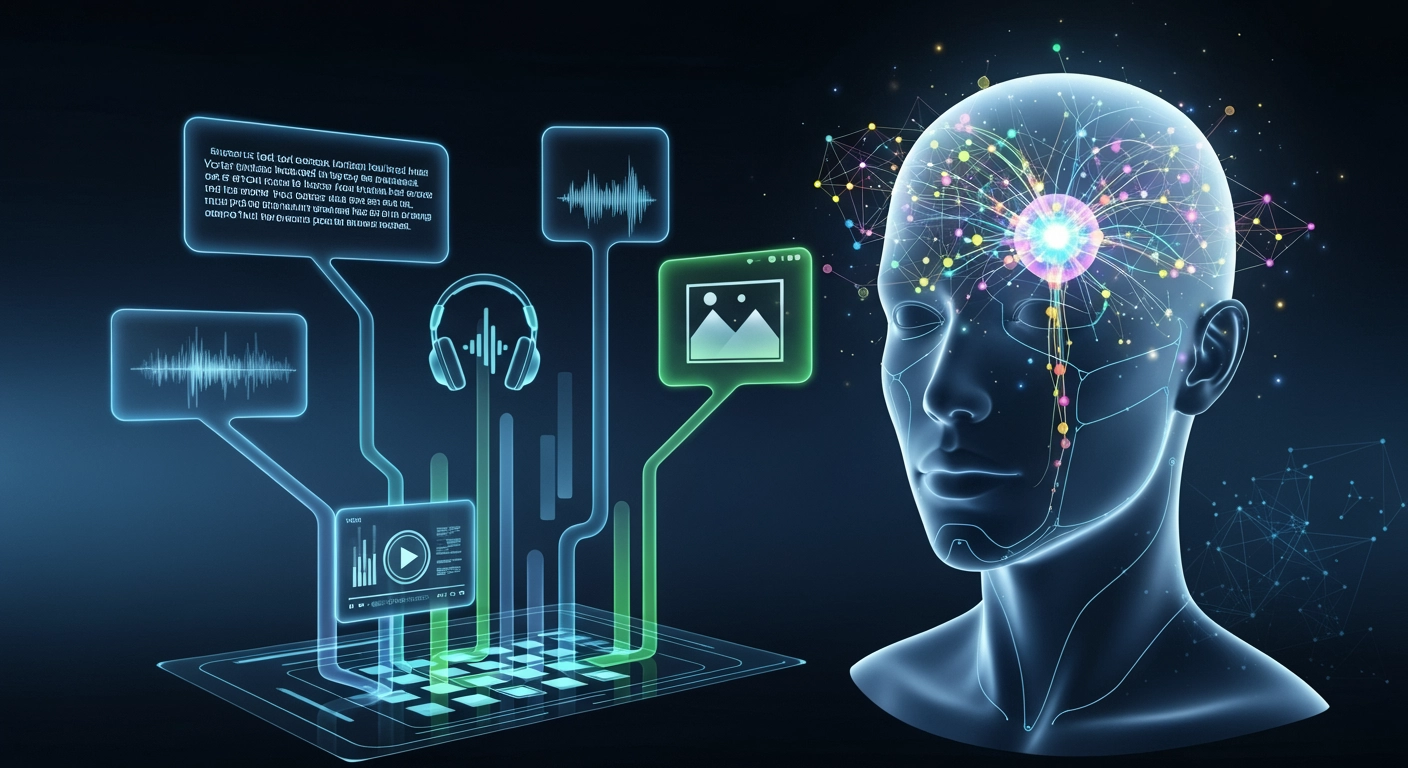
In the world of artificial intelligence, one of the most powerful and transformative trends of the moment is advanced multimodal AI. This technology is redefining how we interact with machines, how data is processed, and how more complete and human-like responses are generated.
What is Multimodal AI?
Multimodal AI is a type of artificial intelligence capable of processing and combining information from different types of data: text, audio, images, and even video. Unlike traditional models that focus on a single modality — for example, text only or images only — multimodal systems interweave different sources to generate richer and more contextualized responses.
Practical example: A multimodal model can analyze a medical image, read a clinical report, and listen to a voice recording from the patient to provide a comprehensive evaluation. This integrative capability is what makes it a powerful tool across multiple sectors.
Real-World Applications of Multimodal AI
The impact of this technology is already visible across various industries. Here is how it is being applied in the real world:
Healthcare. More accurate clinical diagnosis by combining images (X-rays, scans) with written medical histories, and patient monitoring through real-time video and audio.
Marketing and Customer Experience. Emotion analysis in customer videos to improve advertising campaigns, and automatic generation of visual and textual content from spoken briefs.
Education. Creation of more immersive educational experiences through interactive lessons that combine text, voice, and image, as well as translation and summarization of visual content for students with specific needs.
Security and Surveillance. Real-time analysis of video and audio to detect suspicious behavior, and recognition of visual and verbal patterns in criminal investigations.
What Advantages Does Multimodal AI Offer in Data Analysis?
By bringing together different sources of information, multimodal AI offers a deeper and more complete vision. Here are some of its main advantages: expanded context, as it understands not only what is said, but how it is said and what is shown; error reduction, since having multiple sources corrects possible failures from a single input; greater precision in predictions, as the combination of signals improves the training of predictive models; and richer emotional and semantic analysis, especially useful in areas such as customer service, human resources, and mental health.
How to Start Using Multimodal AI in Your Business
Although this technology is still evolving, there are an increasing number of tools and platforms that allow it to be implemented without needing to be an AI expert.
Steps to integrate multimodal AI: Evaluate your data sources — do you have images, text, audio, or video that can be combined? Define the objective — do you want to improve customer service, optimize processes, or personalize content? Choose an appropriate platform — OpenAI, Google DeepMind, and other companies already offer multimodal APIs. Train the model with your own data — the higher the quality and diversity of data, the better the results. Monitor and adjust — like all AI, it requires continuous review and progressive learning.
The Future is Multimodal
Artificial intelligence is no longer limited to understanding text or recognizing images. Today, with multimodal AI, it is capable of interpreting the world in a way that is closer to how humans do it — through multiple senses at the same time.
This capability not only improves the quality of responses, but opens up a new range of possibilities for innovation, personalization, and efficiency across all sectors.
If your organization is not yet exploring the power of multimodal AI, now is the time to start.
At QALEON, we are committed to technological advancement to revolutionize the business world. That is why we have developed SineQia®, an innovative AI-powered 360 platform that provides real-time tracking of KPIs and key metrics related to business sustainability.
With SineQia® you can make informed decisions based on accurate data, optimize your processes, and meet your sustainability objectives efficiently and transparently.