
Introduction
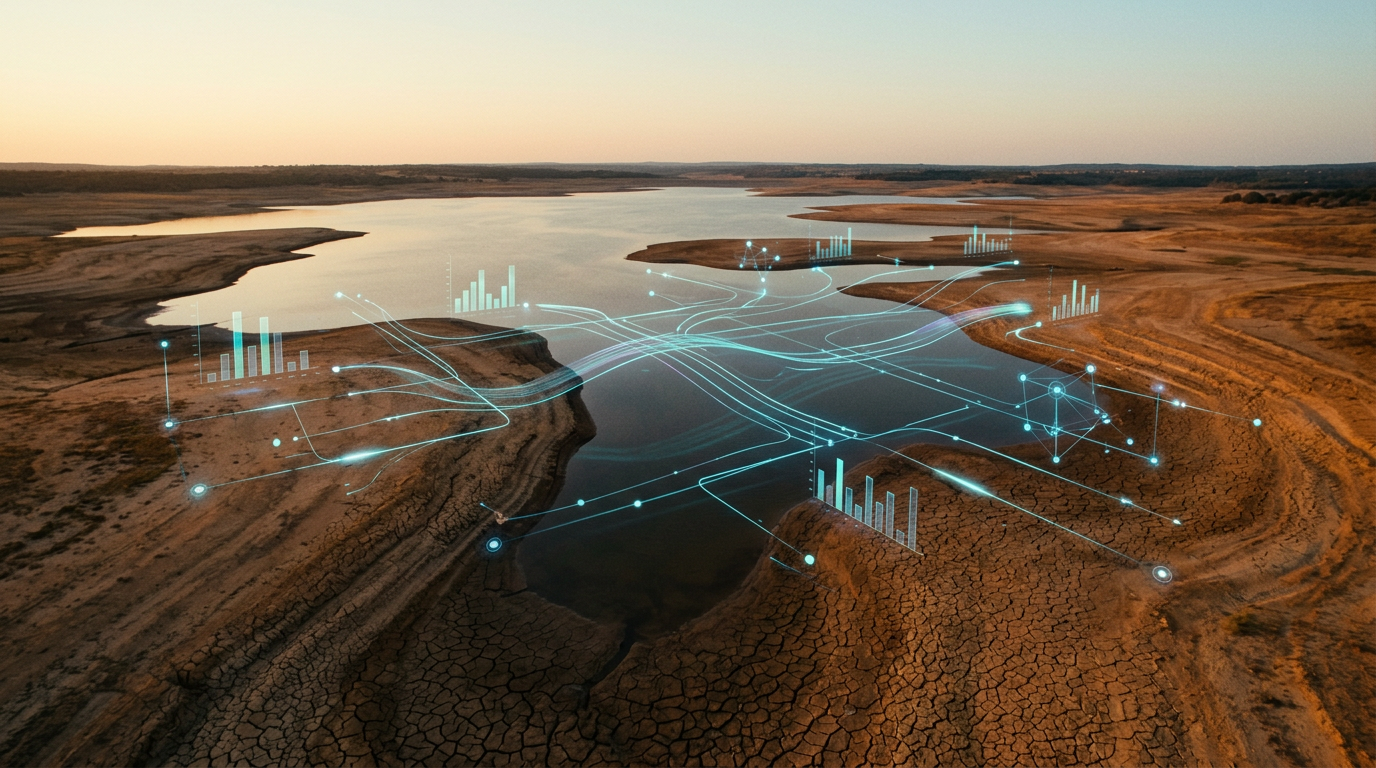
Water scarcity no longer arrives as a surprise — it arrives as a delay. AI water risk management addresses a very specific gap: quarterly reports and manual estimates lag behind conditions that can shift in a matter of weeks. This article looks at how industrial, agricultural and energy companies are replacing static assessments with continuously updated data, and what that shift means for anyone who has to make decisions before the problem shows up on a balance sheet.
Why Traditional Methods Fall Short
What exactly is water risk for a business?
Water risk is the probability that scarcity, excess or declining water quality will affect a company’s operations, costs or reputation through its value chain.
The issue isn’t a lack of data — it’s how scattered that data is: regulatory filings, local measurements, satellite imagery and scientific studies that rarely speak the same language. A sustainability team can spend weeks reconciling this manually, by which point conditions have already moved on.
From Static Reports to Continuous Monitoring
How does AI catch a risk before it becomes a crisis?
AI models applied to hydrology continuously process local measurements, historical series and unstructured sources, turning that volume of data into updated risk indicators rather than one-off snapshots. One striking example: a recent study trained neural networks to predict river discharge across Japanese basins with no physical gauges, covering over 43% of the country’s landmass. The model reached predictive reliability comparable to gauged stations — a level of accuracy manual methods simply can’t match.
Applying It in Industry, Agriculture and Energy
Which sectors are already feeling the impact?
Food manufacturing and irrigated agriculture feel it first: a plant that anticipates supply restrictions can reschedule production shifts before a cut actually hits. In the energy sector, falling hydropower output during drought pushes up wholesale prices; a predictive model lets an energy trader adjust its purchasing mix weeks in advance instead of reacting once prices have already spiked.
From Water Risk to Sustainability Reporting
Why does this also belong on the sustainability team’s desk?
Water is one of the material topics required under CSRD’s environmental standard E3, and companies must back their exposure and mitigation plans with data, not estimates. Platforms like SineQia® connect these water risk indicators directly to ESG reporting, so sustainability and operations aren’t working from two different sets of numbers for the same problem.
In Summary
AI water risk management replaces static reports with continuously updated indicators. This lets industry, agriculture and energy companies anticipate water restrictions before they hit production or costs. AI models can predict basin behaviour even without physical sensors, with recent studies showing correlation reliability above 90%. Water is also a material topic under CSRD, so this data feeds directly into sustainability reporting. Anticipating water risk is now an operational decision, not just an environmental one.
Let’s Talk
If your business depends on water to operate — in production, energy or the supply chain — waiting for the quarterly report is no longer an option. If you want to explore how this applies to your business, let’s talk.