
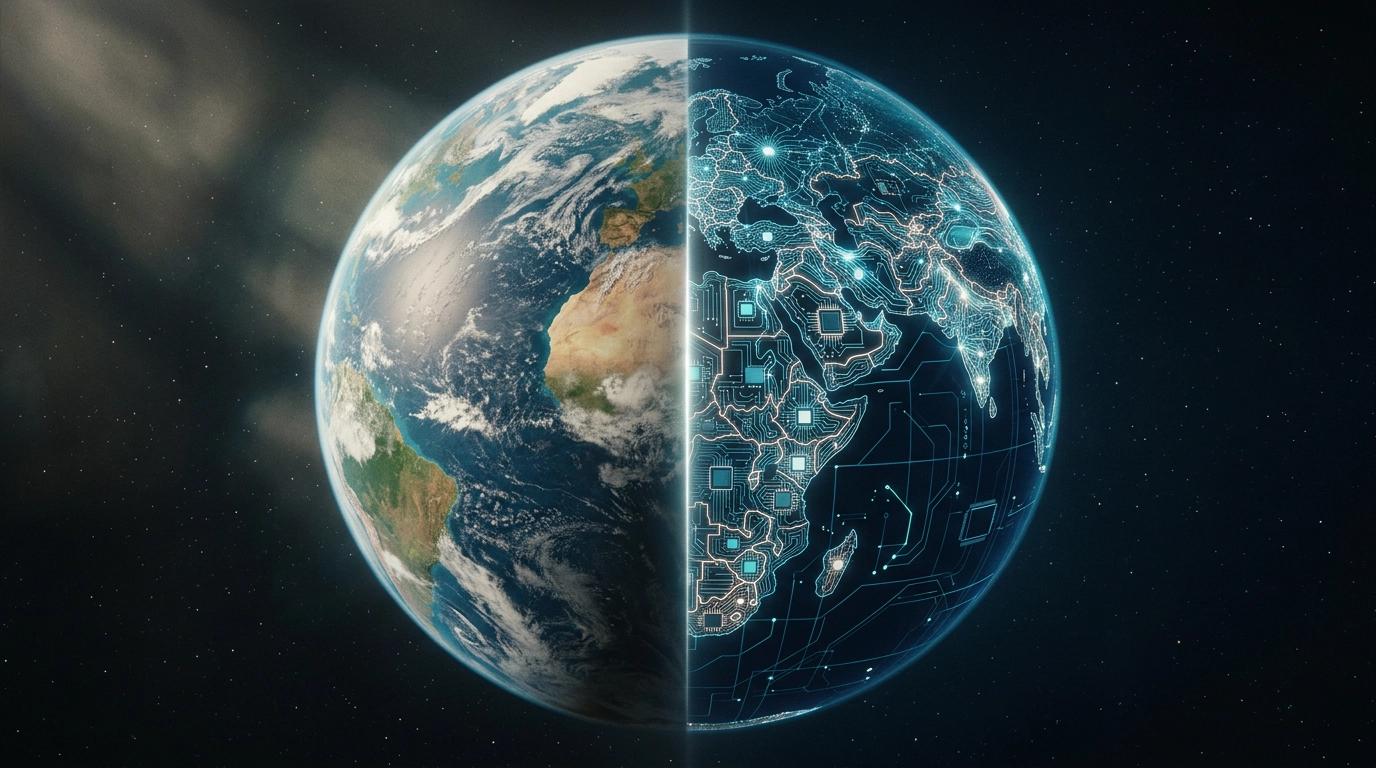
This week, at Google I/O 2026 held on May 19th in Mountain View, Gemini Omni was once again at the centre of the stage — this time with a description that goes well beyond the usual incremental upgrade. Google’s engineers presented it as a step toward what they call a world model: an intelligence capable of reasoning about the world in a way that is closer to how a human being does it. Demis Hassabis was direct from the stage: artificial general intelligence is «just a few years away».
The demo was impressive, no question. But the concept behind it is what deserves attention. Because if language models changed the way companies process information, world models are pointing at something deeper: changing the way AI makes decisions.
What exactly is a world model?
A language model — the kind of AI we have known well since 2022 — learns to predict the next word. It does so with remarkable accuracy, and most of its usefulness flows from that. But it does not understand physics. It does not know that a glass falls if you drop it. It does not model causal relationships between events. It works with text and statistical patterns, not with representations of the real world.
A world model, by contrast, builds an internal representation of how an environment works: what causes what, how systems evolve over time, what will happen if a variable changes. Think of how a child learns that water spills if you tilt a glass. No one hands them Newton’s equations. They observe, interact and build a mental model. World models attempt to replicate precisely that process.
How does this differ from the generative AI we already use? Generative AI operates fundamentally on digital data and text; a world model reasons about objects, forces, causality and time. The difference is not one of degree — it is one of nature.
Why this changes the game for businesses
For the past two or three years, most organisations have followed the same pattern: adopt an LLM, connect it to internal workflows and start automating tasks. It has worked. But that advantage is eroding fast. When every company has access to the same models via API, the tool stops being the differentiator.
World models open up a different dimension: the ability to simulate before acting. Some concrete examples of what that means in practice:
- In logistics and supply chain, a system with a world model can simulate the impact of a port closure in Asia on European inventory, calculate alternative routes and anticipate delays before they happen. Not just describing the problem — predicting it and proposing solutions.
- In industry and robotics, training a robot in a simulated environment with realistic physics before deploying it on the factory floor substantially reduces the cost of trial and error. Prior simulation in digital twins based on world models allows movements and interactions to be planned before execution in the physical world.
- In healthcare, researchers are already working with systems that unify genomic, proteomic and clinical data to model complex biological systems and accelerate the development of treatments.
- In risk management, weather forecasting platforms use world models to predict heavy rainfall 48 hours in advance at 2 km resolution — data that global insurers are already using to estimate catastrophic losses.
The business logic is straightforward: moving from describing what happened to predicting what will happen. And from there, to simulating what could happen under a given decision.
Where the technology actually stands in May 2026
Are world models ready to be deployed in any company tomorrow? Not exactly. But they are not science fiction either, and the capital flowing into this field gives a fairly clear signal of where things are headed.
Over the past twelve months, investment in world model startups has exceeded $12 billion, tripling the 2024 figure. Yann LeCun — one of the founding fathers of modern AI and a Turing Award winner — left his role at Meta in late 2025 to found AMI Labs in Paris, raising over $1 billion in its first round with the explicit goal of building AI based on world models rather than language models. In parallel, Fei-Fei Li is leading World Labs with a valuation exceeding $5 billion, also focused on visual understanding of the environment.
This is not an academic bet. It is a signal that the industry considers world models the next critical layer of artificial intelligence. Those who understand this transition today will have an advantage when the tools reach scale — just as those who understood transformers in 2020 were better positioned when the LLM boom arrived.
What executives should actually be doing right now
There is a question that comes up frequently in leadership conversations around this topic: when should my company start worrying about world models? The honest answer: it depends on your vertical, but sooner than you think.
World models are not going to replace the systems you already have overnight. They will integrate progressively, particularly in the areas where simulation, scenario prediction and causal reasoning add real value: operations, supply chain, financial planning, predictive maintenance, product development.
What makes sense to do now is prepare the ground. That involves three concrete things:
- Audit the quality and structure of your own data. World models learn from rich, structured data with temporal context. If your organisation’s data is a mess, no AI architecture — old or new — is going to perform well.
- Identify the processes where scenario simulation would add differential value. You do not need to wait for a proprietary world model to start thinking in terms of «what if?».
- Keep a close eye on how the platform providers you already use are incorporating these capabilities. As this week’s I/O 2026 announcements made clear, large multimodal models are already integrating basic elements of physical world understanding. The transition is gradual, but it is under way.
The regulatory angle: the EU AI Act and high-risk systems
In Europe, the AI Act — in force since August 2024 and with progressive application through to 2027 — classifies AI systems by risk level. A world model applied to operations, logistics or healthcare decisions can easily fall into the high-risk category, which entails strict requirements around transparency, auditability and human oversight.
This is not an obstacle — it is a framework that compels organisations to implement these technologies responsibly, with documentation of decision-making processes and human control mechanisms. When done properly, it reduces adoption risk rather than increasing it. And in a European context where trust in AI remains a critical adoption factor, that framework can become a competitive advantage in itself.
From promise to measurable results
World models represent a qualitative leap in how artificial intelligence can contribute to business strategy. But the gap between a promising technology and a technology that generates real results in a specific organisation does not close by itself.
At Qaleon, we have spent years helping business teams turn advanced AI technology into concrete decisions, optimised processes and measurable results. If you are thinking about how to position your organisation for this transition — or simply want to understand what it means for your sector — we can help you map the path forward. No empty promises, just practical steps grounded in your reality.