
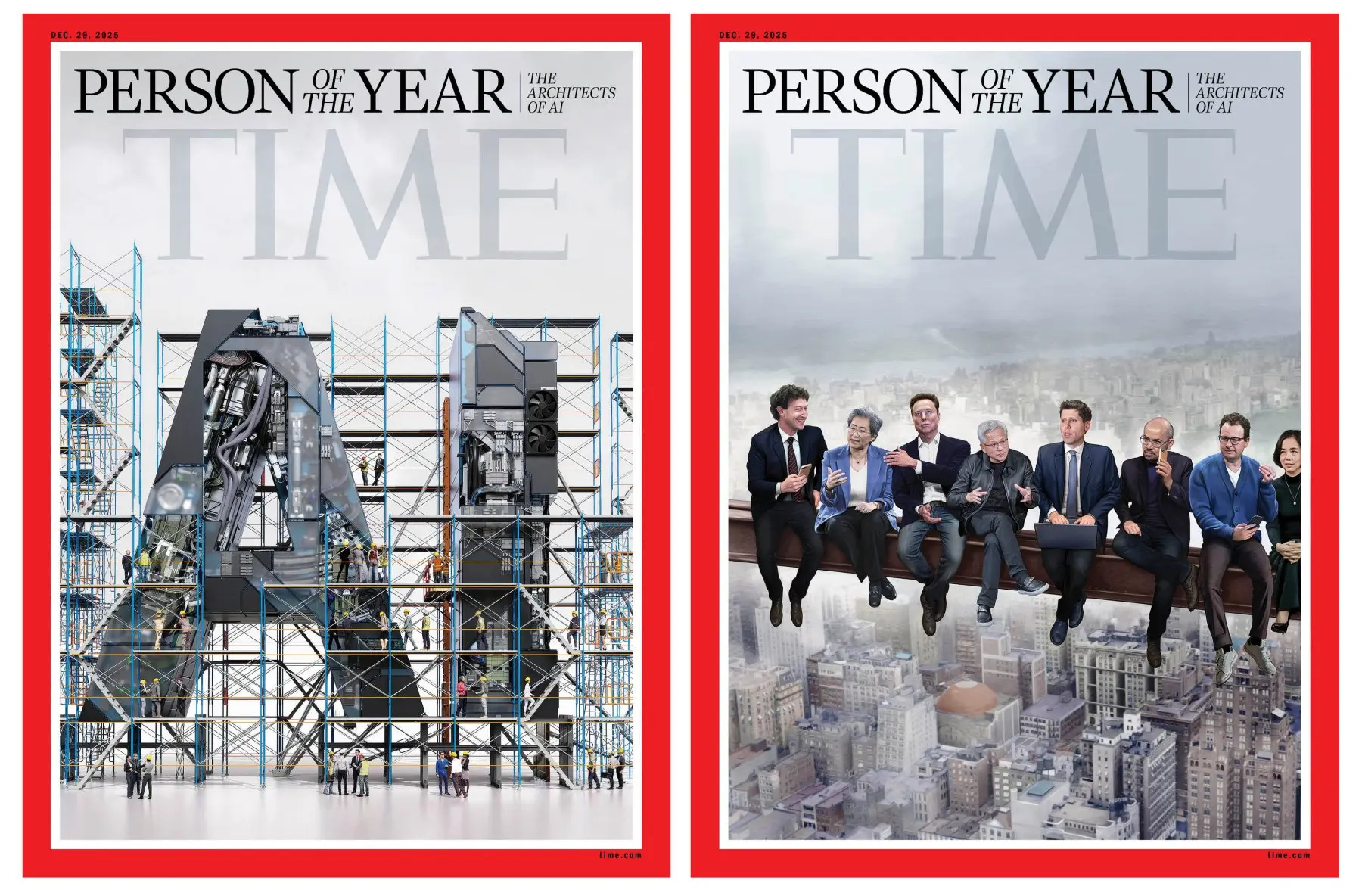
Artificial intelligence has ceased to be a promise of the future and has become the most tangible reality of 2025. TIME recognized this historic shift by designating the «Architects of AI» as Person of the Year — marking the third occasion on which the magazine has granted this distinction to a non-human entity.
Sam Jacobs, editor-in-chief of TIME, was direct in explaining the decision: the year saw the full potential of artificial intelligence roar into view, making it clear that there would be no turning back and no way to opt out. The choice did not fall on the technology itself, but on the minds that design, build, and deploy it.
The Cover That Symbolizes a New Era
TIME prepared two covers for this edition. The first, by digital artist Jason Seiler, reinterprets the iconic 1932 photograph «Lunch Atop a Skyscraper,» replacing the workers of the Great Depression with today’s technology leaders: Mark Zuckerberg (Meta), Lisa Su (AMD), Elon Musk (xAI), Jensen Huang (Nvidia), Sam Altman (OpenAI), Demis Hassabis (DeepMind), Dario Amodei (Anthropic), and Fei-Fei Li (Stanford).
This group of eight people has accumulated a combined fortune of $870 billion, according to Forbes, much of it generated during the last three years of the AI boom.
The DeepSeek Moment That Shook Silicon Valley
On the very day of Trump’s presidential inauguration in January, a Chinese startup called DeepSeek launched an AI model that rivaled the capabilities of American competitors. This move triggered alarms in Washington and forced an immediate response: the following day, Sam Altman, Larry Ellison, and Masayoshi Son announced Project Stargate at the White House, with a promised investment of up to $500 billion to build AI data centers across the United States.
From Experimentation to Mass Production
What distinguishes 2025 from previous years is the speed of deployment. TIME highlighted how coding tools like Cursor reached $1 billion in annual revenue, becoming one of the fastest-growing startups in history. At Anthropic, Claude now writes up to 90% of its own code. Nvidia nearly quadrupled its chip production while only doubling its workforce.
Energy demand has skyrocketed. Data centers will account for 8% of all US electricity consumption by 2030 — double the figure from 2023. Major tech companies — Amazon, Microsoft, Google, and Meta — plan to jointly invest $370 billion this year in AI infrastructure.
The Price of Progress
This transformation comes with clear trade-offs. According to a Yahoo/YouGov survey, 53% of Americans believe AI could eventually «destroy humanity.» Jobs are disappearing, disinformation is proliferating, and distinguishing the real from the artificial is becoming increasingly difficult.
Thomas Husson, principal analyst at Forrester, explains that 2025 was the year AI went from being a technology explored by early adopters to becoming part of the daily lives of a critical mass of consumers. Among Generation Z, 93% regularly use AI chatbots — an unprecedented level of penetration.
The Verdict of History
«For delivering the age of thinking machines, for dazzling and alarming humanity, for transforming the present and transcending the possible, the Architects of AI are TIME’s Person of the Year 2025,» the magazine declared. The question is no longer whether AI will transform our lives, but how we will navigate that inevitable change.
At companies like QALEON we are already leading this transformation in the Spanish market, applying artificial intelligence and advanced analytics to revolutionize sectors such as talent development and healthcare monitoring. While tech giants build the global AI infrastructure, specialized companies demonstrate that the true value lies in applying this technology to solve concrete problems and improve people’s lives.