
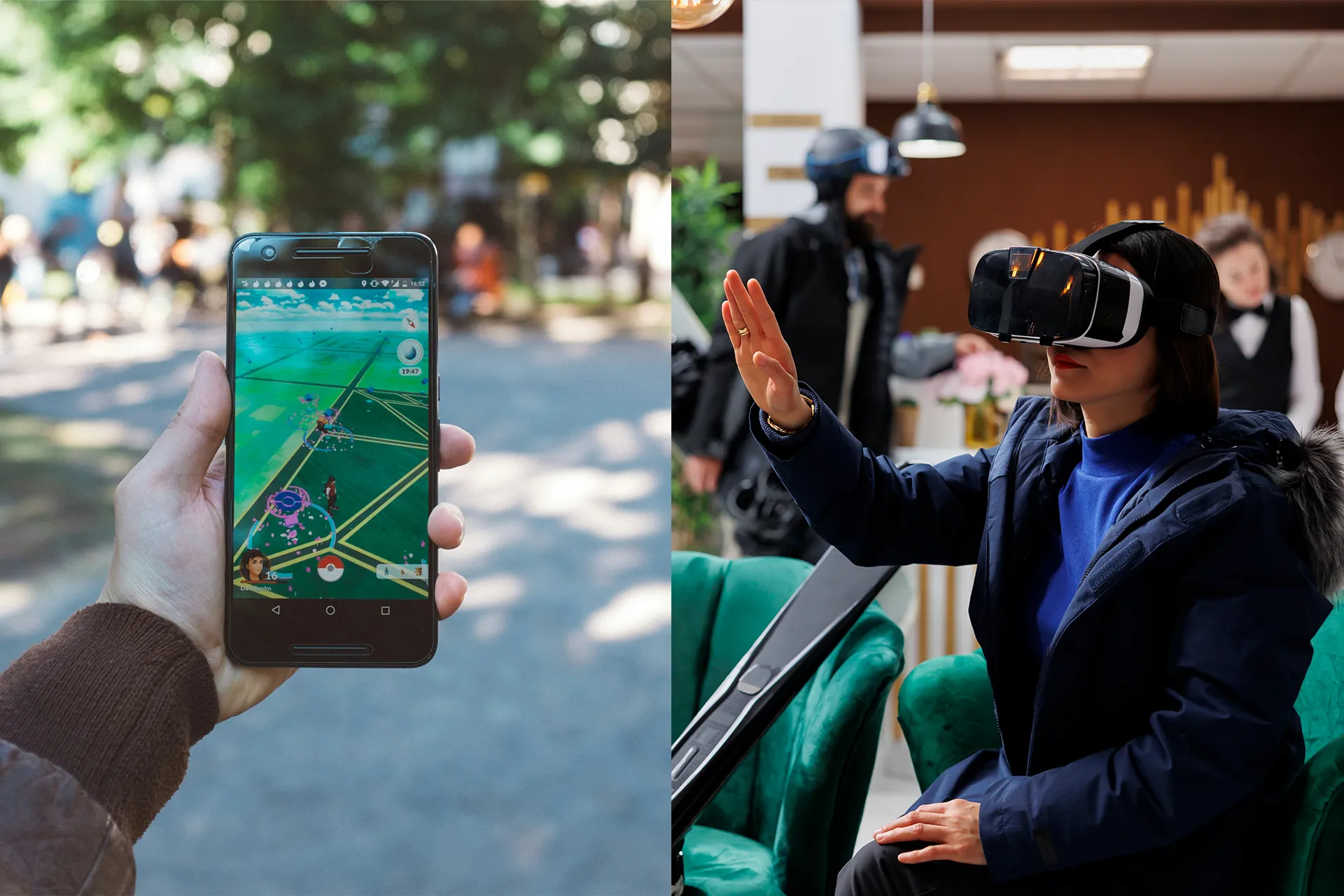
In a fully digitalized society, the boundaries between the digital world and the physical world are becoming increasingly blurred. This is where Augmented Reality (AR) and Virtual Reality (VR) come into play — two disruptive technologies that are continuously evolving toward an ever more technological reality. Both AR and VR share a key characteristic: they transform the way we interact with the world around us. Their applications range from entertainment to science. Both are very much a present reality, but above all they represent the future, which is why it is important to differentiate between them in order to make the most of what they offer.
What is Augmented Reality (AR)?
According to the Internet University (UNIR), augmented reality brings the digital world closer to the real one, allowing virtual elements to integrate organically into the space where the user interacts.
This technology integrates digital elements such as images, sounds, or text into the real world using devices like smartphones or tablets. Thanks to Augmented Reality, users benefit from virtual elements always in relation to the physical environment they are in.
One of the main advantages this technology offers is precisely its interaction with the real world. This means the user is not isolated from their surroundings, allowing for seamless integration with the physical environment. Accessibility is another significant advantage, as no complex equipment is needed to enjoy it.
What is Virtual Reality (VR)?
According to the Internet University (UNIR), virtual reality immerses a person in a simulated space in which they can interact or move around using technological devices.
Unlike AR, VR does not take the physical environment into account, immersing the user in a completely virtual world. This requires specific devices such as VR headsets or glasses. Despite being commonly associated with video games, its applications go far beyond that. Today, simulations are used in medicine, education, and even military training.
Its main advantage is the total immersion it provides. This allows us to create and experience very specific situations that would otherwise be extremely difficult or even dangerous to replicate.
The Future of AR and VR
Both Augmented Reality and Virtual Reality are technologies in constant evolution. While AR will transform the way we interact with the world, VR will allow us to create increasingly advanced simulations. Furthermore, all signs point to these two technologies becoming increasingly complementary as new technological advances emerge, giving rise to mixed realities that will bring us new functionalities.
At QALEON, we are committed to technological advancement in pursuit of a more sustainable and cleaner future. That is why we have developed SineQia®, an innovative 360 platform that provides real-time tracking of KPIs and key metrics related to business sustainability.
With SineQia® you can make informed decisions based on accurate data, optimize your processes, and meet your sustainability objectives efficiently and transparently.